A Montreal Memory
At first glance, the world of book launches seems predictable.
There is an author who—usually with quiet modesty—tries not to overtalk their own book. There is a moderator who asks the questions. And there is the audience: curious, critical, and polite all at once.
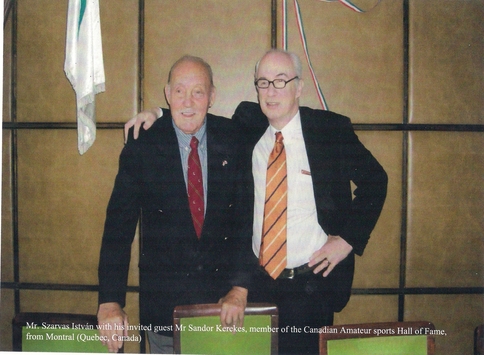
But in Montreal, in September 2008, within the walls of the Hungarian House, the evening drifted gently away from that familiar script. The conversation was led by Sándor Kerekes.
Yet he was more than simply the moderator of the event. As one of the voices featured in the volume, he also belonged to the book’s “inner world.” It was a rare and unusual situation: when the interviewee becomes the one asking the questions.
That evening, the Hungarian House seemed lit in a special way. Not because of the decorations or the ceremony, but because of that elusive feeling only diaspora community spaces can carry. On the walls hung photographs recalling the past; in the air floated fragments of soft Hungarian conversation; and there was a quiet certainty that everyone present knew where they had come from—even if decades separated them from that particular “where from.”
Sándor Kerekes’s questions were precise.
They came with the discipline of an athlete, without unnecessary detours. He was not interested in rhetorical flourish, but in substance. Just as there is no room on the piste for wasted movement, there was no space in this conversation for empty phrases.
By then, his name was already well known in the world of sport. A former foil fencer and member of the Canadian national team, he later became a defining figure as a sports administrator, serving as president of the Quebec Modern Pentathlon Federation.
At one point in the conversation—perhaps precisely because of this unusual reversal of roles—an unexpected anecdote emerged. Smiling, Sándor Kerekes remarked:
“You know, István, fencing and conducting interviews have more in common than we tend to think.”
The audience watched with warm amusement.
“In both,” he continued, “the real question is when to attack... and when it is wiser to wait.”
The room laughed. And the author—who this time remained in the role of respondent—did not argue.
It was true: a badly timed question can be just as mistaken a thrust as a rushed move on the piste. And a well-aimed question, asked quietly, can sometimes reach its target more accurately than the most spectacular attack.
That half-sentence, offered as a seemingly light remark, in fact said more about the craft than long methodological explanations ever could. From that point on, the conversation changed almost imperceptibly.
It was no longer a book launch, but a dialogue. No longer a moderated event, but an exchange of thought. The questioner knew what it felt like to answer. The respondent knew the responsibility of asking. And the Hungarian House in Montreal quietly provided the frame for this rare balance.
At the end of the evening, during the signing, Sándor Kerekes came over once more.
“You see,” he said with gentle good humor, “tonight I got a little even.”
“In what way?” I asked.
“Once, I was the interviewee. Tonight, I asked the questions.”
And in that sentence was everything the I Asked — They Answered series truly meant: not merely questions and answers, but encounters.
Between people. Between life stories. Between roles.
In Montreal, on that evening, in the borderless space of the Hungarian language.